Scholarship Opportunities at Japanese Universities for Tanzanian Students 2027
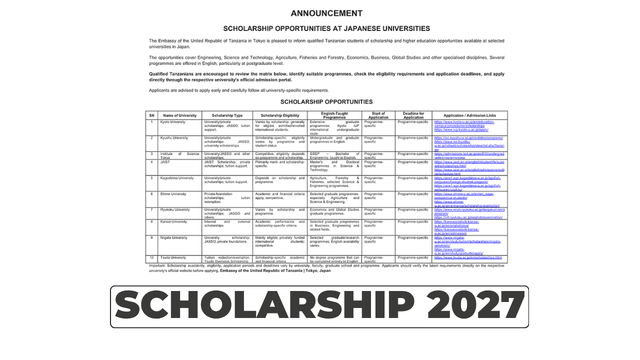
The Embassy of the United Republic of Tanzania in Tokyo has announced scholarship and higher education opportunities for qualified Tanzanian students at selected universities in Japan 2027. The opportunities cover fields including engineering, science and technology, agriculture, fisheries, forestry, economics, business, global studies and other specialised areas.
Several programmes are available in English, particularly at postgraduate level. However, scholarship availability, eligibility requirements, application periods and deadlines differ by university, faculty, graduate school and programme.
Students interested in these opportunities should identify a suitable programme, review its specific requirements and apply through the relevant university’s official admission or scholarship platform.
Scholarship Opportunities at a Glance
| University | Main Opportunities / Fields | English-Taught Study | Scholarship Information |
|---|---|---|---|
| Kyoto University | Undergraduate and graduate programmes, including specialised international programmes | Extensive international programmes; availability varies | University and other scholarship opportunities |
| Kyushu University | Selected graduate programmes, particularly agriculture, science and engineering | English availability varies by programme | JASSO and other scholarships |
| Institute of Science Tokyo | Science and technology programmes, including the GSEP undergraduate programme | GSEP is taught in English | Scholarship eligibility varies |
| JAIST | Graduate programmes in science, engineering and related fields | English availability varies by programme | JAIST and private scholarships |
| Kagoshima University | Agriculture, fisheries and selected science and engineering programmes | Programme-specific | Scholarship and programme requirements apply |
| Ehime University | Selected programmes across relevant academic fields | Programme-specific | University and other scholarship opportunities |
| Ryukoku University | Economics and selected graduate programmes | English programmes available in selected areas | University/private scholarships and tuition support |
| Kansai University | Selected graduate programmes in business, engineering and related fields | English availability varies | University/private scholarships |
| Niigata University | Selected graduate programmes | Programme-specific | University, JASSO and private-foundation scholarships |
| Tsuda University | Selected programmes | English availability varies | Tuition reduction/exemption and Tsuda Overseas Scholarship |
1. Kyoto University
Kyoto University is included among the institutions identified by the Embassy for scholarship and higher-education opportunities.
The information supplied highlights undergraduate and graduate opportunities, including international programmes. Applicants should check the individual programme to determine whether it is taught in English and whether they qualify for available financial support.
Official scholarship information: Kyoto University scholarships 2027
International undergraduate application: Kyoto University IUP application information 2027
2. Kyushu University
Kyushu University offers opportunities covering selected graduate areas, with particular relevance to fields such as agriculture, science and engineering.
English availability depends on the programme. Scholarship opportunities include JASSO and other forms of financial support listed by the university.
Programme information: Kyushu University international programmes 2027
Scholarship information: Kyushu University scholarships 2027
3. Institute of Science Tokyo
Institute of Science Tokyo is included in the opportunities, particularly through its Global Scientists and Engineers Program (GSEP).
GSEP is an undergraduate programme in science and engineering taught in English. Students interested in this route should review the programme’s admission requirements and application schedule directly.
Official GSEP information: Institute of Science Tokyo GSEP admissions 2027
4. Japan Advanced Institute of Science and Technology (JAIST)
Japan Advanced Institute of Science and Technology provides graduate-level opportunities in science, engineering and related areas.
The university provides information on scholarships and financial support as well as admission schedules. Requirements and application periods are programme-specific.
Scholarships: JAIST scholarship information 2027
Admission schedule: JAIST admission schedule 2027
5. Kagoshima University
Kagoshima University is highlighted for opportunities related to agriculture, fisheries and selected science and engineering programmes.
Applicants should check the relevant foreign-student programme and admission guidelines because requirements and application periods depend on the programme.
Foreign student programme: Kagoshima University foreign student programme 2027
Application guidelines: Kagoshima University application guidelines 2027
6. Ehime University
Ehime University is another institution listed in the Embassy’s scholarship information.
The opportunities are programme-specific, and applicants should review the university’s prospective-student information before selecting a course. Scholarship and tuition-exemption information is also available from the university.
Prospective student information: Ehime University prospective students 2027
Scholarships and tuition exemption: Ehime University scholarship information 2027
7. Ryukoku University
Ryukoku University offers selected graduate opportunities, including programmes in economics and other specialised areas.
Applicants should confirm English-language availability and admission requirements for the specific programme they intend to pursue. Scholarship opportunities may include university or private scholarships, JASSO and tuition support.
Graduate economics programme: Ryukoku University graduate economics programme 2027
International examination information: Ryukoku University international admissions 2027
8. Kansai University
Kansai University is included for selected graduate programmes, particularly in areas such as business, engineering and related disciplines.
The availability of English-taught study depends on the programme. Applicants should review the graduate-school admission information before applying.
English programmes: Kansai University English graduate programmes 2027
Admission information: Kansai University graduate admissions 2027
9. Niigata University
Niigata University provides selected graduate opportunities and scholarship options for international students.
Scholarship support may include university scholarships, JASSO and private-foundation opportunities. Applicants should check the relevant graduate programme before applying because requirements vary.
Scholarships: Niigata University scholarships 2027
Graduate application information: Niigata University graduate applications 2027
10. Tsuda University
Tsuda University is also listed among the institutions offering relevant higher-education and scholarship opportunities.
The university provides scholarship information including tuition reduction or exemption and the Tsuda Overseas Scholarship. Eligibility is scholarship-specific and may depend on academic and financial criteria.
Official scholarship information: Tsuda University scholarships 2027
Who Can Apply?
The opportunities are intended for qualified Tanzanian students interested in pursuing higher education in Japan.
However, there is no single eligibility requirement covering all ten universities. Academic qualifications, nationality conditions, language requirements, scholarship criteria and admission requirements can differ according to the university and programme.
Students should therefore avoid assuming that eligibility for one institution automatically applies to another.
For example, some opportunities are aimed at undergraduate applicants, while many of the listed English-taught opportunities are at postgraduate level. Applicants should first identify their intended level of study and field before checking the applicable requirements.
Choosing the Right Opportunity
A practical way to approach these opportunities is to start with the academic programme rather than the scholarship.
First, identify the subject you want to study, such as engineering, agriculture, economics or science. Then check whether the university offers that programme at your intended level and whether it is taught in English.
After identifying a suitable programme, review:
- Admission qualifications
- Language requirements
- Application period
- Scholarship eligibility
- Tuition and other financial support
- Required application documents
- Whether a separate scholarship application is required
This approach can help applicants avoid applying for financial support that does not apply to their chosen programme.
Application Process
Applications should be made directly through the relevant university’s official admission or scholarship system.
Because the universities use different application procedures, applicants should:
- Select a university and programme that matches their academic background.
- Open the university’s official programme or admissions page.
- Read the current admission requirements carefully.
- Check whether the programme is available in English.
- Review the scholarship options and eligibility conditions.
- Confirm the programme-specific application opening and closing dates.
- Prepare the required academic and supporting documents.
- Submit the application through the university’s designated official platform.
- Keep records of the application and submitted documents.
Important Information About Deadlines
The information provided by the Embassy does not give one common application deadline for all ten universities.
Application periods are programme-specific and may also vary between faculties, graduate schools and scholarship schemes.
Applicants should therefore check the latest deadline on the official university website before preparing or submitting an application.
Before You Apply
Start preparing early, particularly if your chosen programme requires academic documents, language evidence or other supporting materials.
It is also important to distinguish between university admission and scholarship applications. A scholarship may have its own eligibility conditions and application procedure, and admission to a university does not necessarily mean that every scholarship listed by that institution will be available to you.
Applicants should also use only official university websites when checking current requirements and submitting applications.
Important Notice
Scholarship availability, eligibility, application periods and deadlines vary by university, faculty, graduate school and programme.
The Embassy’s information should therefore be used as a starting point for identifying opportunities. Applicants are advised to verify the latest requirements directly with the respective university before applying.
English-language availability also varies. Although several programmes are offered in English, particularly at postgraduate level, applicants should confirm the language of instruction for their specific programme.
Official Source and Application Links
The scholarship and higher-education opportunities were communicated by the Embassy of the United Republic of Tanzania in Tokyo.
The official university links supplied for applicants are:
- Kyoto University scholarships
- Kyoto University IUP application
- Kyushu University programmes
- Kyushu University scholarships
- Institute of Science Tokyo GSEP
- JAIST scholarships
- JAIST admissions
- Kagoshima University foreign student programme
- Kagoshima University application guidelines
- Ehime University prospective students
- Ehime University scholarships and tuition exemption
- Ryukoku University graduate programme
- Ryukoku University international admissions
- Kansai University English programmes
- Kansai University admissions
- Niigata University scholarships
- Niigata University graduate applications
- Tsuda University scholarships
For Tanzanian students considering study in Japan, the key next step is to select a suitable programme and then verify its current admission and scholarship requirements directly with the university. This is particularly important because the opportunities do not share a single application deadline or eligibility system.